Wedding cakes
Wedding Cake Styles: A Plain Guide to the Looks and Their Names
Tiers, coverings, finishes and decoration, explained plainly, so you can describe what you want and have a maker picture the same thing you are picturing.
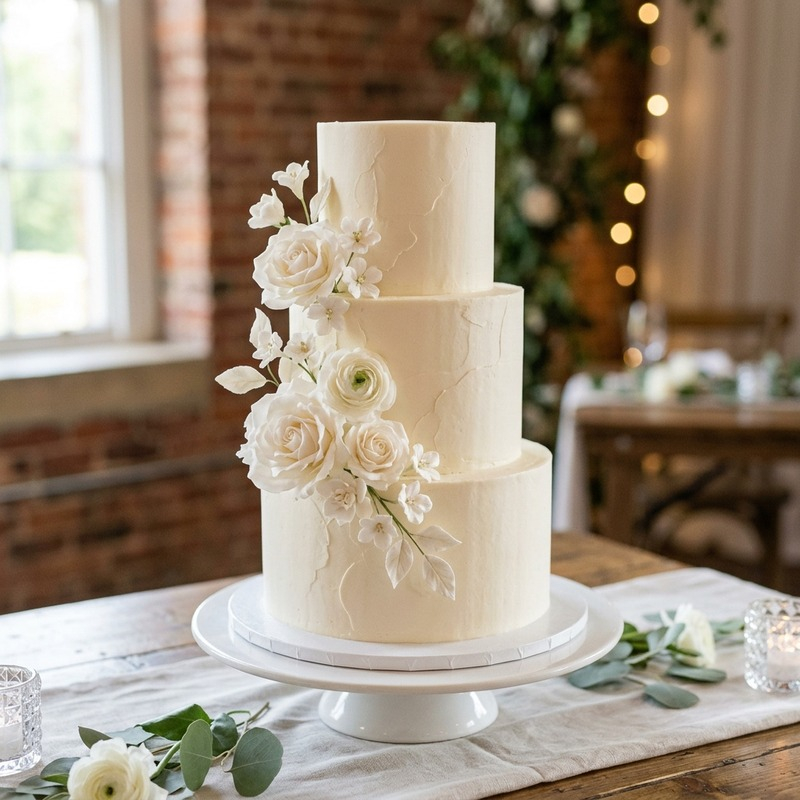
Most couples arrive at the cake conversation with a saved folder of photos and no idea what links them. The images all feel right, but when someone asks what you want, the only words available are "something simple" or "like this one, but different". That is a hard brief to quote on, and it is the reason two makers can read the same request and come back with completely different cakes.
This guide gives you the vocabulary. Tiers, coverings, finishes, decoration and the words people use for the overall look, explained plainly so you can describe what you want and have a maker picture the same thing you are picturing. By the end you should be able to write three or four sentences about your wedding cakes brief that actually mean something.
Structure
Tiers, and what they actually do
A tier is one stacked layer of cake, usually with its own internal structure, sitting on a board above the one below it.
Tiered wedding cakes look the way they do because of height and proportion, but the number of tiers is driven first by something much less romantic: how many people you are feeding.
Tier count and guest count are linked, although not in a straight line. Tiers get narrower as they go up, so each one adds fewer servings than the one beneath it. A 3 tier wedding cake gives a maker room to build real height and a classic silhouette while still landing in the serving range most Australian weddings need. It is the most commonly requested shape for a reason, and it suits a mid-sized guest list without looking either sparse or enormous.
Height is the other half of the job. Tiers control the proportions of the cake, so a maker may suggest taller individual tiers to get presence without adding another layer, or a dummy tier to build height when the servings are already covered. Work out how many servings you need before you settle on a tier count, because the number is a result, not a starting point.
Sometimes a tiered cake is the wrong answer altogether. If your venue has limited display space, if the cake has to travel a long way in summer, or if you simply want to spend the budget on flavour instead of structure, a wedding sheet cake served from the kitchen is a sensible option. Some couples order a small decorated cake for cutting and photos, with sheet cake behind the scenes for the room. Nobody at the reception notices, and the budget goes further.
The outer layer
Coverings and finishes
The covering is the outer layer that gives a cake its look and its behaviour. Three dominate Australian weddings, and each one trades something away.
Buttercream is butter based, soft, and gives that slightly handmade, edible-looking finish that photographs warmly. It takes texture beautifully: combing, ruffles, palette knife strokes, soft ripples. Because it is butter based, it softens as the temperature climbs, which matters for an outdoor summer reception or a cake standing in a warm room.
Fondant is a rolled sugar covering that gives the smoothest, sharpest surface of the three and holds crisp edges and precise detail. Heat and humidity are its weak point in different ways: a humid room can leave the surface tacky or cause colours to bleed, so a maker will think about air conditioning and about how long the cake stands before cutting.
Ganache is chocolate and cream set firm. It is often used underneath fondant to create hard, square edges, and it can also be the finish in its own right. It is the sturdiest of the three in warm conditions, which is why makers reach for it when a cake has to travel or sit outside.
Covering | How it looks | How it handles heat | What it allows |
|---|---|---|---|
| Buttercream | Soft, slightly textured, warm and handmade | Butter based, so it softens as temperature rises | Ruffles, combing, palette knife texture, soft colour blending |
| Fondant | Smooth, matte, sharp edged and very even | Holds shape better than buttercream, but humidity can leave it tacky or bleed colour | Crisp edges, painted and printed detail, sculpted work, bold colour |
| Ganache | Dense and satiny, or a firm base under fondant | The sturdiest of the three in warm conditions | Hard square edges, structural support, travel and outdoor display |
Finish is a separate decision from covering. The same buttercream can be scraped smooth, left in soft swirls, textured with a comb, or taken back so the sponge shows through at the edges in the stripped-back look people usually call a naked or semi-naked cake. Fondant can be matte, pearlised, hand painted or wrapped in sugar panels. If you want to see the vocabulary applied to finished cakes, our cake styles page walks through the looks visually.
The words people use
Traditional, elegant and contemporary: what the words mean
These three words get used constantly and mean almost nothing on their own. Nearly every couple describes their cake as elegant. Here is what each one actually points to, so you can choose the right one honestly.
- Traditional.Traditional wedding cakes borrow from the formal British and Australian wedding table: white or ivory, multiple tiers stacked or pillared, symmetrical, with piped detail such as scrollwork, lace patterns, beading or embroidery effects. Decoration is applied evenly around the cake rather than placed to one side. Fruit cake sits in this tradition too, although most couples now choose a lighter sponge and keep the look. If your reference photos are symmetrical, pale and finely detailed, the word you want is traditional.
- Elegant.Elegant describes restraint, not expense. Elegant wedding cakes tend to be smooth and pale, with one controlled gesture: a single sweep of sugar flowers, a thin band of gold at each tier join, a soft watercolour wash. The detail is sparse and deliberate, the palette is usually tonal, and nothing competes for attention. Elegant is a good word when your photos show cakes with a lot of plain surface and one small, confident feature.
- Contemporary.Contemporary wedding cakes break the symmetry on purpose. Expect asymmetric decoration weighted to one corner, unusual proportions, sharp architectural edges, textured and sculptural surfaces, deeper or unexpected colours, and elements such as pressed botanicals or hand painted panels. If the cakes you have saved look more like objects than desserts, contemporary is your word.
You can honestly combine them. A traditional silhouette with contemporary decoration is a real brief, and saying so tells a maker far more than "elegant" ever will.
Where the labour sits
Decoration: florals, handwork and toppers
Decoration is where most of the labour sits, and where quotes separate from one another.
Fresh flowers are the quicker option and usually the cheaper one, though they need to be prepared and placed close to the time, often on site, and the blooms available depend on the season. Sugar flowers are made by hand, petal by petal, and a single large bloom can take hours. They hold their shape in conditions that would wilt fresh flowers, they last forever as a keepsake, and the time involved is a real part of the price. Anything built around a dense arrangement of blooms, which people commonly call a floral cake, will land very differently in a quote depending on which of the two you mean, so say which.
Handwork covers everything applied by the maker: piping, hand painting, stencilling, sculpted sugar figures, metallic leaf, moulded detail. It is charged in hours. A smooth cake with one painted panel can cost more than a heavily decorated one, because the painting is slow and a smooth surface leaves nowhere to hide.
Toppers range from a small monogram or a bloom to a sculpted piece. Keep in mind that a topper has to be lifted off before cutting, so its weight and base matter. If you want to understand how these choices move a quote, our guide to what a wedding cake costs sets out where the money goes.
Conditions on the day
Matching the style to the venue and the season
An Australian wedding puts real pressure on a cake, and this is where a beautiful reference photo meets reality.
Heat is the first consideration. A cake standing in a warm marquee, on a beach, in a vineyard or in a courtyard in January is in very different conditions from one in an air conditioned reception room, and your maker will steer the covering accordingly.
Humidity is a separate problem from heat, and it affects coverings differently, which is why a maker may ask about the venue before they ask about the design. Direct sun on a display table is worth mentioning too, along with whether the cake sits outside for the ceremony and photos before moving indoors.
Then there is transport and standing time. A long drive on a hot day, a gravel driveway, a cake room with no refrigeration, or a four hour gap between delivery and cutting all shape what a maker will recommend building. Tell them the venue, the date, the expected conditions and roughly when the cake will be cut. A maker who knows all that will design something that still looks like your reference photo at the moment it is photographed.
The brief
Turning a style into a brief
Put the vocabulary together and a brief writes itself. Name five things:
- The covering.Buttercream, fondant or ganache, or say you are open to advice for the conditions.
- The finish.Smooth, textured, semi-stripped, painted, metallic.
- The tier count or the servings.Give the guest number if you are unsure of the tiers.
- The palette.Two or three colours, not a mood.
- One reference image.One, with a sentence on what you like about it and what you would change.
Add the date, the venue and the expected conditions, and you have a brief that different wedding cake designers can quote on comparably. That last point is the whole purpose of the exercise: when every maker is answering the same brief, the differences in their quotes tell you something real about the cake, instead of telling you that they each imagined a different one.
In short
Describe it once, properly
You do not need to know the trade terminology to get the cake you want, but a handful of precise words will take you further than a folder of photos. Decide the covering and the finish, know roughly how many servings you need, name your palette honestly, and pick the word that truly describes the look you are after instead of defaulting to elegant.
Write that down once, get cake maker quotes and every maker you approach is working from the same picture.
You have the words
Now send the same brief to everyone
Covering, finish, servings, palette and one reference image. One brief, and the quotes you get back are finally comparing the same cake.